

Articles
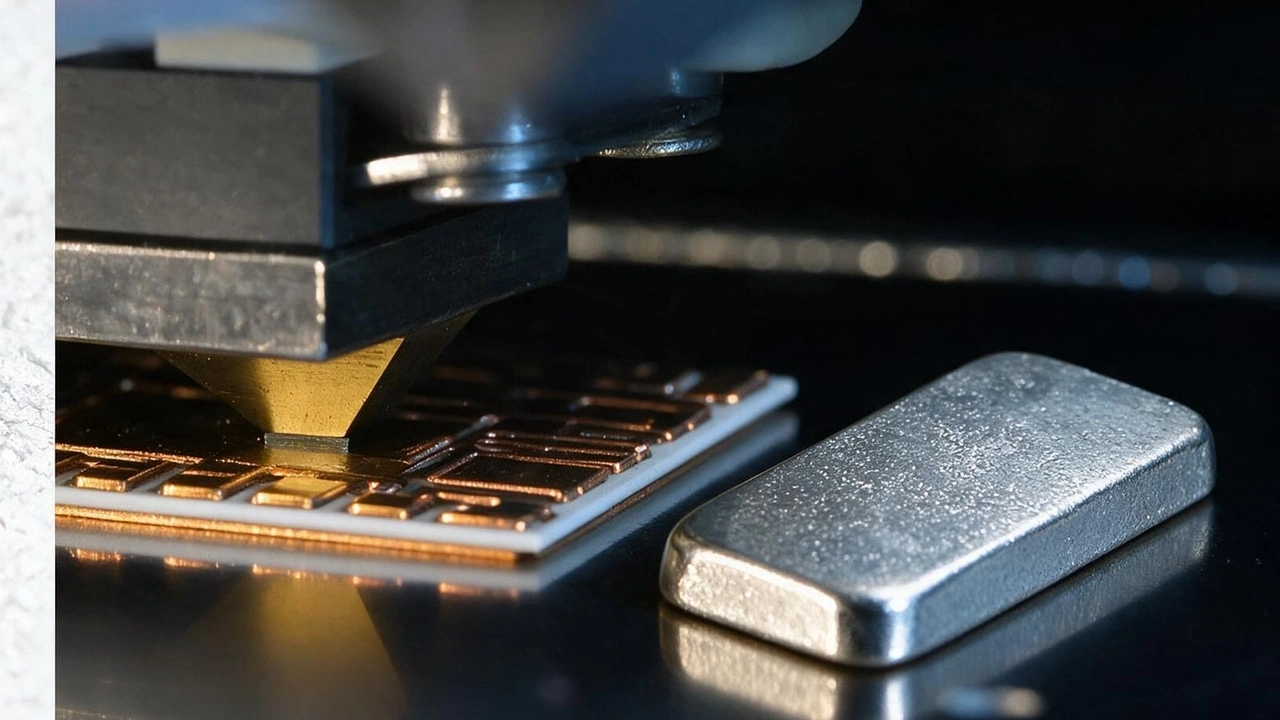
SILVER AND AI: NEW MATERIALS AMIDST DECLINING INDUSTRIAL DEMAND
Silver-containing materials are used in semiconductor assembly. But the available sources do not show how much silver goes into AI chips, and AI growth did not prevent overall industrial silver demand from falling in 2025.
Between the Die and the Substrate
One stage of semiconductor device assembly is to attach the silicon die to a substrate or lead frame. This process is called die attach. The bond must hold the die in place and help dissipate heat; whether an electrical contact is needed through this layer depends on the package design.
Silver-containing materials are used in this application. For example, the epoxy-based electrically conductive adhesive Henkel LOCTITE ABLESTIK 8301 contains silver and is designed for die attach in semiconductor packages Henkel LOCTITE ABLESTIK 8301 product page. The silver in such adhesives provides the necessary electrical conductivity and aids in thermal management.
New Materials for AI/HPC
High-performance computing (HPC) systems and artificial intelligence (AI) accelerators operate under heavy loads, generating significant heat. Efficient heat dissipation from the die directly impacts the chip's performance and stability.
In response to these demands, manufacturers are developing new materials. On August 19, 2026, Henkel introduced the LOCTITE ABLESTIK CDF900 die attach film, designed for applications including AI/HPC chip packaging Henkel release on CDF900. According to the manufacturer, this film material provides thermal conductivity exceeding 8 W/(m·K) and allows for more precise control over the bond line thickness compared to liquid adhesives Henkel release on CDF900. The composition of the thermally conductive filler in CDF900 is not disclosed in this release.
Sector Growth and the Wider Market
Growth in specific sectors does not necessarily increase the metal's aggregate consumption. According to a survey by the Silver Institute and Metals Focus, published on April 15, 2026, overall industrial demand for silver in 2025 decreased by 3% to 657.4 million troy ounces Silver Institute review of 2025 demand. Consumption in the electrical and electronics segment fell by 2%.
The survey's authors estimate that AI infrastructure, the automotive industry, and power grids supported consumption. However, this positive factor was offset by weakness in the photovoltaics (solar panels) sector Silver Institute survey. The high cost of the metal and fierce competition among manufacturers accelerated efforts to reduce silver use and find substitutes in solar cell production. The April forecast for 2026 also projected a further decline in industrial demand by approximately 3%, primarily due to photovoltaics Silver Institute survey.
Thrifting and Recycling
Material thrifting and recycling address different challenges: the former reduces the amount of silver per product, while the latter returns the metal to the supply chain.
Recycled materials are a separate consideration. In its announcement of the new material for AI/HPC, Henkel mentions a collaboration to use recycled silver powder sustainability section in the Henkel release. Replacing primary silver with secondary silver does not, in itself, mean a reduction in the total consumption of the metal.
What Remains Unknown
Henkel's 8301 product page confirms that silver-containing materials are used in semiconductor packaging; the CDF900 release demonstrates the development of materials for AI/HPC. But these two examples are not enough to quantify how much silver is used specifically for AI. The publications reviewed do not provide the mass fraction of silver in the materials, their supply volumes for AI, or a list of chips in which they are used.
These sources cannot reliably tell us how many additional ounces of silver AI growth requires. That estimate needs data on material composition and supply volumes. The wider market also depends on changes in demand from other users, including solar cell manufacturers.
Editorial analysis, not individual investment advice.