

Articles
TETHER BUYS UP TO TWO TONNES OF GOLD A WEEK: WHY CRYPTO WANTS PHYSICAL METAL
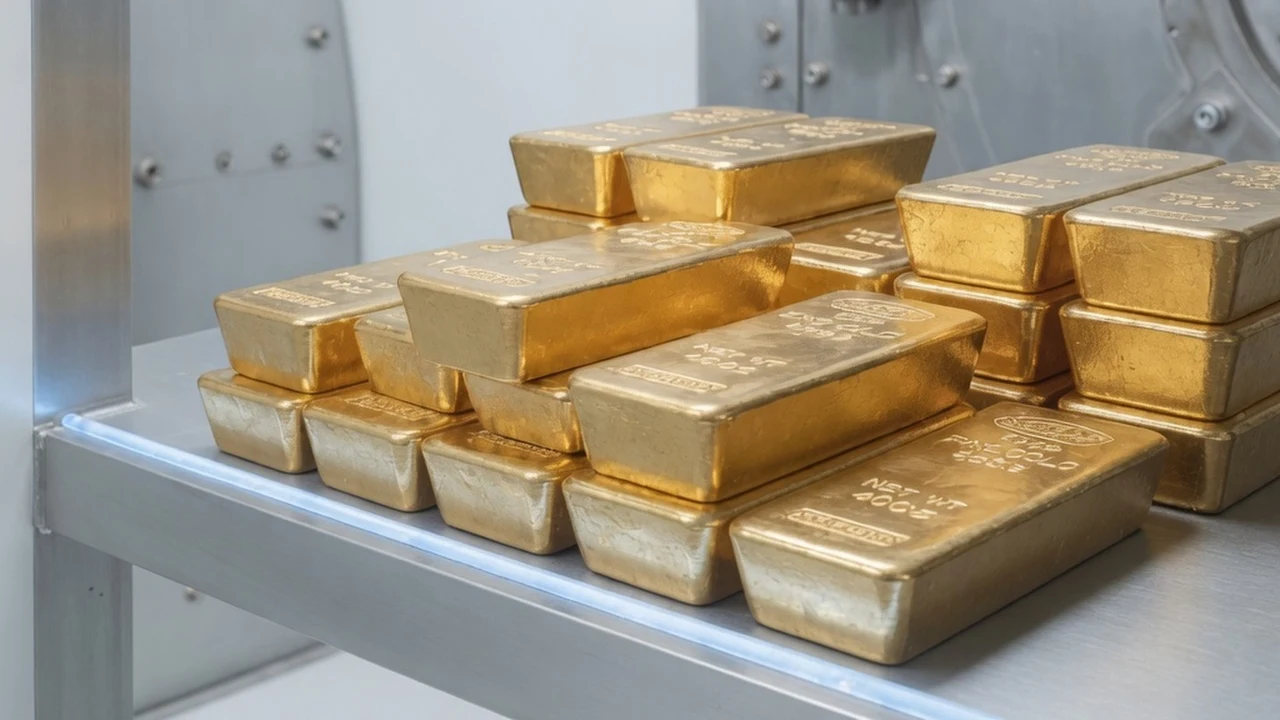
Somewhere in Switzerland is a vault that Tether chief executive Paolo Ardoino describes to journalists as “a place straight out of a James Bond film.” According to Bloomberg and CoinDesk, as much as two tonnes of gold are added every week. Convert that into one-ounce coins and the result is six coins a minute, around the clock, seven days a week. In money terms, it is roughly $1 billion a month.
By Dan Vastrik, 03.07.2026
Somewhere in Switzerland is a vault that Tether chief executive Paolo Ardoino describes to journalists as “a place straight out of a James Bond film.” According to Bloomberg and CoinDesk, as much as two tonnes of gold are added every week. Convert that into one-ounce coins and the result is six coins a minute, around the clock, seven days a week. In money terms, it is roughly $1 billion a month.
The buyer is a company whose main product is digital: USDT, the world's largest stablecoin. By mid-2026, its total stock of physical metal was already estimated at 140–154 tonnes—the equivalent of a medium-sized country's gold reserve, assembled by a private company in a short period.
The irony interests me more than the numbers. A company with no branches or cash desks—only code and servers—has chosen an asset from another age for its reserve: heavy, tangible, and dependent on vaults, guards and scales. It is now moving that asset by the truckload.
A note on accuracy. Viral retellings still cite “one tonne a week” and “16 tonnes in total.” Those figures are out of date by an order of magnitude. Today's verifiable estimates are as much as two tonnes a week and roughly 150 tonnes in total.
How Much, and How Fast
Bloomberg reports that Ardoino confirmed the company intended to maintain this pace “for at least several more months.” At current prices, two tonnes a week is worth more than a billion dollars a month.
For scale, Poland—the world's largest central-bank gold buyer—purchased 102 tonnes in the whole of 2025. At its current pace, Tether covers roughly that amount in a year. A private company is moving as fast as the most aggressive central bank on the planet.
Estimates of the total reserve vary between sources, from about 140 to 154 tonnes. That is normal for a rapidly growing stockpile: the number becomes outdated almost every week. A dated range is more honest than false precision.
XAUT and USDT: Gold Has Two Jobs
Gold performs two roles within the Tether system.
The first is the XAUT token (Tether Gold). Each token is backed by one troy ounce of London Good Delivery gold held in a Swiss vault. The growth in backing speaks for itself: XAUT was supported by 520,089 ounces at the end of 2025 and 707,747 ounces—about 22 tonnes—by 31 March 2026, with a market value of more than $3.3 billion. That is an increase of more than one-third in a quarter.
The second is USDT's own reserve. At the end of March 2026, about 132 tonnes of gold sat in the stablecoin's reserves, representing roughly 10% of the reserve structure. The foundation remained unchanged: US Treasury bills, at about $117 billion, still dominated, with roughly $7 billion held in Bitcoin. Gold is not displacing dollar instruments; it is being added alongside them as a hard layer.
A “Gold Central Bank”: The Company's Logic
Ardoino states the ambition without hesitation: to turn Tether into “one of the largest gold central banks in the world.” His argument rests on the asset's characteristics. A 10–15% allocation to hard assets, he says, serves as a hedge that “cannot be frozen or sanctioned” in the way custodial dollar balances can. The company has also discussed putting part of its gold reserve to work—for example, as collateral for loans.
Fact and interpretation need to be separated here. The volumes and pace are facts, supported by attestations and reporting. The motives are the company's own account and should be presented in exactly that status. A more cynical observer might add that a gold reserve is also a credibility signal to regulators and clients. Both interpretations, however, lead to the same place.
What Is Known About Tether's Gold
| Measure | Value | Source / date |
|---|---|---|
| Purchase rate | up to 2 tonnes/week (~$1bn/month) | Bloomberg / CoinDesk, 2026 |
| Total holdings | ~140–154 tonnes | Reports, mid-2026 |
| XAUT backing | 520,089 → 707,747 oz | Attestation, end-2025 → 31 March 2026 |
| Value of XAUT | >$3.3bn | 31 March 2026 |
| Gold in USDT reserves | ~132 tonnes (~10%) | End-March 2026 data |
| Custody | Vault in Switzerland | Company statements |
Key Factors
Why the entire gold market is watching this story:
- Scale. Around 150 tonnes is the size of a medium country's national reserve, accumulated by one private company.
- Pace. Up to two tonnes a week is sustained additional physical demand, not a one-off transaction.
- The choice of physical metal. The issuer of a digital dollar holds not only government securities but metal in a vault.
- Tokenisation is not “gold from thin air.” According to the attestations, each XAUT is backed by a specific ounce. It is a digital wrapper around a physical asset, not a replacement for it.
Conclusion
There is no secret buying operation here: volumes are disclosed in quarterly attestations, and the company's chief executive states the pace openly to journalists. The interesting point is different. A company that is digital by definition has chosen, for its own resilience, an asset that cannot be printed or erased with a database entry. This is one private case, not a signal to the market and certainly not an investment guide. But as an illustration of the logic behind a “hard asset with no issuer,” it is more eloquent than most. The money of the future, it turns out, also wants to stand on something very old—on a shelf in a Swiss vault, to be precise.
This material is for educational purposes only and is not investment advice. It discusses the strategy of a third-party company, not a recommendation. Gold and cryptoasset prices can move in either direction, and past performance does not guarantee future results.
In Brief: Frequently Asked Questions
How much gold does Tether hold? Estimates for mid-2026 put the total at about 140–154 tonnes of physical gold, accumulated at a rate of up to two tonnes a week—roughly $1 billion a month. The figure is growing quickly, which is why it varies between sources.
What is XAUT? Tether Gold (XAUT) is a token, each unit of which is backed by one troy ounce of physical London Good Delivery gold stored in Switzerland. On 31 March 2026, its backing stood at 707,747 ounces worth more than $3.3 billion.
Why is Tether buying gold? According to chief executive Paolo Ardoino, it is a hard-asset hedge—targeted at 10–15%—that cannot be frozen or sanctioned in the way dollar balances can. Some gold also diversifies the reserves backing the USDT stablecoin. This is the company's own position.
Is XAUT backed by physical gold? Yes, according to the attestations: every XAUT token corresponds to one ounce of physical London Good Delivery gold in a Swiss vault, and the volume of backing is disclosed quarterly.
Sources
- Bloomberg / CoinDesk (2026) — purchase rate (up to 2 tonnes/week, ~$1bn/month), total holdings, custody and statements by Paolo Ardoino.
- Tether quarterly attestation, Q1 2026 — XAUT backing (707,747 oz) and gold's share of USDT reserves.
- The Block / CoinDesk — the “gold central bank” strategy and plans to put the reserve to work.