

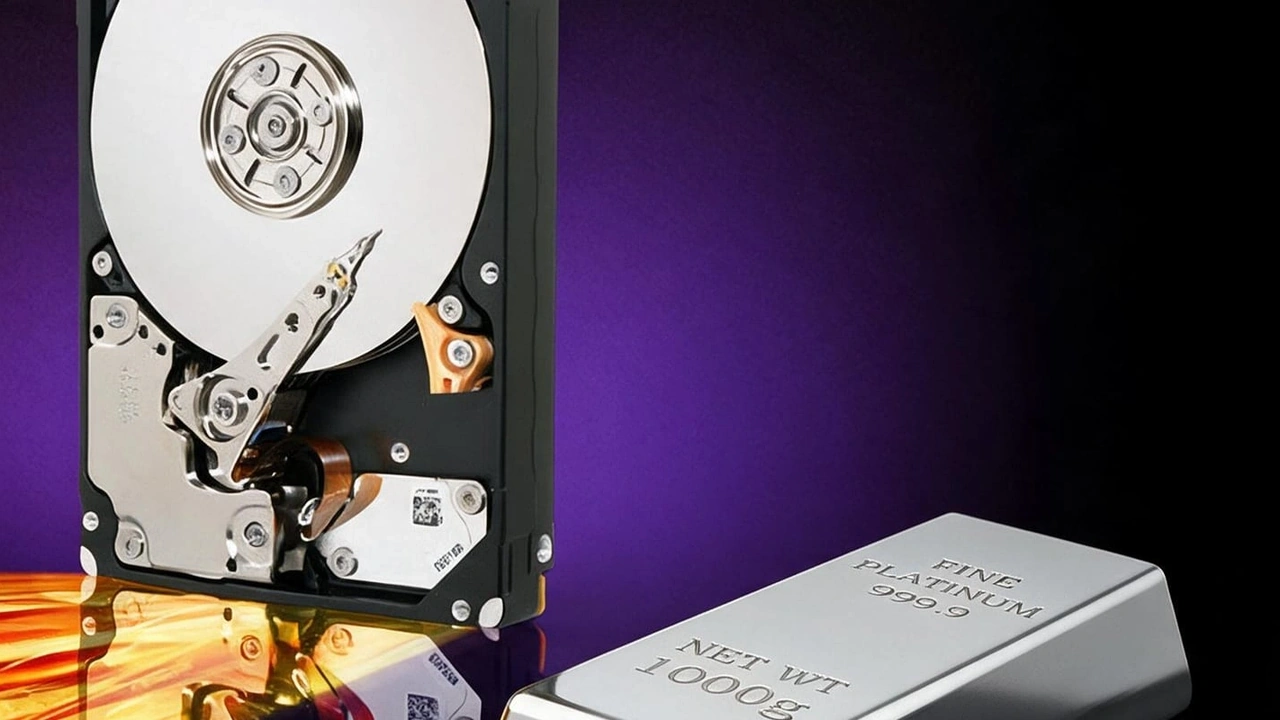
In the Seagate Mozaic 3+ platform, an iron-platinum alloy helps preserve data at high recording densities, and local heating makes writing easier. But to calculate the demand for platinum, knowing the drive's design is not enough—material composition and shipment volumes are also needed.
The Challenge of High-Density Magnetic Recording
To increase hard drive capacity, manufacturers reduce the area required to record a single bit. As magnetic grains shrink, thermal fluctuations can alter their magnetization if their stability is insufficient. This creates a risk of data loss—a problem associated with the superparamagnetic limit.
Overcoming this barrier requires a material with very high magnetic anisotropy—a strong preference for a specific direction of magnetization. Seagate uses an iron-platinum (FePt) alloy for this purpose Seagate Mozaic 3+ White Paper. Its structure allows for the creation of much smaller, stable magnetic grains. However, this high stability introduces another challenge: such a material is extremely difficult to remagnetize using a standard recording head.
What HAMR Technology Does
The solution is heat-assisted magnetic recording (HAMR). Its principle is to briefly and locally heat the recording medium at the exact moment of writing.
- Magnetic Layer: The drive uses platters with a special magnetic layer made of an FePt alloy, formed over crystalline underlayers on a special glass substrate Seagate Mozaic 3+ White Paper.
- Local Heating: Laser energy is delivered through an optical system and a near-field transducer, briefly heating a small area of the magnetic layer.
- Writing: The heating temporarily reduces the material's resistance to remagnetization. The magnetic part of the HAMR head then sets the magnetization of the heated area and writes the data.
- Cooling: After rapidly cooling, the area once again becomes resistant to random remagnetization Seagate Mozaic 3+ White Paper.
This process does not burn holes in the disk or heat the entire platter; instead, it affects only the target nanoscale area at the moment of writing.
From Technology to Product
HAMR technology is already being used in commercial products targeting cloud data centers that handle AI workloads, among others. On March 3, 2026, Seagate announced it had begun volume shipments of Mozaic 4+ drives to two major cloud providers. These drives have capacities of up to 44 TB Seagate press release on Mozaic 4+.
According to Seagate, this generation achieves over 4 TB of data per platter. The company's roadmap projects 10 TB per platter and drives with capacities up to 100 TB, but this applies to future products, not those currently shipping Seagate press release on Mozaic 4+.
From Device to Market
A Johnson Matthey report from May 14, 2026, mentions data center construction as a factor influencing the consumption of platinum and ruthenium (Ru) in the magnetic layers of hard drives Johnson Matthey PGM Market Report 2026.
However, growth in one technology sector doesn't always translate to an increase in overall demand for a metal. The same report forecasts a 6% fall in total ruthenium consumption in 2026. Demand from the hard-disk sector is expected to reach a five-year high, but not to offset the decline in demand from the chemical industry Johnson Matthey PGM Market Report 2026. Demand from one sector can rise even as consumption across the whole market falls.
What Data Is Missing to Assess Demand
The reviewed materials lack sufficient data to estimate the demand for platinum driven by HAMR technology. Such a calculation would require:
- The shipment volume of drives with HAMR technology.
- The exact mass of platinum used in a single drive.
- The market share of HAMR drives in the overall HDD market.
- The recycling and recovery rates for platinum from end-of-life devices.
The Seagate technical documentation reviewed confirms the use of an FePt alloy but does not provide data on the mass of platinum per drive Seagate Mozaic 3+ White Paper. Without this figure and shipment data, it is impossible to derive a reliable estimate in metric tons or troy ounces from the sources provided.
Platinum is indeed used in the magnetic material for commercial HAMR technology, and Mozaic drives are being shipped to cloud operators. However, these sources do not provide a quantitative assessment of the platinum demand specifically from AI workloads.
This material explains the technology and does not constitute individual investment advice.